Friday, May 13, 2011

EDUCATION OF MECHANICAL ENGINEERING ALL OVER THE WORLD


Degrees in mechanical engineering are offered at universities worldwide. In Brazil, Ireland, China, Greece, Turkey, North America, South Asia, and the United Kingdom, mechanical engineering programs typically take four to five years of study and result in a Bachelor of Science(B.Sc), Bachelor of Science Engineering (B.ScEng), Bachelor of Engineering (B.Eng), Bachelor of Technology (B.Tech), or Bachelor of Applied Science (B.A.Sc) degree, in or with emphasis in mechanical engineering. In Spain, Portugal and most of South America, where neither BSc nor BTech programs have been adopted, the formal name for the degree is "Mechanical Engineer", and the course work is based on five or six years of training. In Italy the course work is based on five years of training, but in order to qualify as an Engineer you have to pass a state exam at the end of the course.
In Australia, mechanical engineering degrees are awarded as Bachelor of Engineering (Mechanical). The degree takes four years of full time study to achieve. To ensure quality in engineering degrees, the Australian Institution of Engineers accredits engineering degrees awarded by Australian universities. Before the degree can be awarded, the student must complete at least 3 months of on the job work experience in an engineering firm.
In the United States, most undergraduate mechanical engineering programs are accredited by the Accreditation Board for Engineering and Technology (ABET) to ensure similar course requirements and standards among universities. The ABET web site lists 276 accredited mechanical engineering programs as of June 19, 2006. Mechanical engineering programs in Canada are accredited by the Canadian Engineering Accreditation Board (CEAB), and most other countries offering engineering degrees have similar accreditation societies.
Some mechanical engineers go on to pursue a postgraduate degree such as a Master of Engineering, Master of Technology, Master of Science, Master of Engineering Management (MEng.Mgt or MEM), a Doctor of Philosophy in engineering (EngD, PhD) or an engineer's degree. The master's and engineer's degrees may or may not include research. The Doctor of Philosophy includes a significant research component and is often viewed as the entry point to academia. The Engineer's degree exists at a few institutions at an intermediate level between the master's degree and the doctorate.


DEVELOPMENT IN MECHANICAL ENGINEERING


Development


Applications of mechanical engineering are found in the records of many ancient and medieval societies throughout the globe. In ancient Greece, the works of Archimedes (287 BC–212 BC) deeply influenced mechanics in the Western tradition and Heron of Alexandria (c. 10–70 AD) created the first steam engine. In China, Zhang Heng (78–139 AD) improved a water clock and invented a seismometer, and Ma Jun (200–265 AD) invented a chariot with differential gears. The medieval Chinese horologist and engineer Su Song (1020–1101 AD) incorporated an escapement mechanism into his astronomical clock tower two centuries before any escapement can be found in clocks of medieval Europe, as well as the world's first known endless power-transmitting chain drive.
During the years from 7th to 15th century, the era called the Islamic Golden Age, there were remarkable contributions from Muslim inventors in the field of mechanical technology. Al-Jazari, who was one of them, wrote his famous Book of Knowledge of Ingenious Mechanical Devices in 1206, and presented many mechanical designs. He is also considered to be the inventor of such mechanical devices which now form the very basic of mechanisms, such as the crankshaft and camshaft.
Important breakthroughs in the foundations of mechanical engineering occurred in England during the 17th century when Sir Isaac Newton both formulated the three Newton's Laws of Motion and developed calculus. Newton was reluctant to publish his methods and laws for years, but he was finally persuaded to do so by his colleagues, such as Sir Edmund Halley, much to the benefit of all mankind.
During the early 19th century in England, Germany and Scotland, the development of machine tools led mechanical engineering to develop as a separate field within engineering, providing manufacturing machines and the engines to power them. The first British professional society of mechanical engineers was formed in 1847 Institution of Mechanical Engineers, thirty years after the civil engineers formed the first such professional society Institution of Civil Engineers. On the European continent, Johann Von Zimmermann (1820–1901) founded the first factory for grinding machines in Chemnitz (Germany) in 1848.

In the United States, the American Society of Mechanical Engineers (ASME) was formed in 1880, becoming the third such professional engineering society, after the American Society of Civil Engineers (1852) and the American Institute of Mining Engineers (1871). The first schools in the United States to offer an engineering education were the United States Military Academy in 1817, an institution now known as Norwich University in 1819, and Rensselaer Polytechnic Institute in 1825. Education in mechanical engineering has historically been based on a strong foundation in mathematics and science.


Wednesday, May 11, 2011


Mechanical engineering is a discipline of engineering that applies the principles of physics and materials science for analysis, design, manufacturing, and maintenance of mechanical systems. It is the branch of engineering that involves the production and usage of heat and mechanical power for the design, production, and operation of machines and tools. It is one of the oldest and broadest engineering disciplines.
The engineering field requires an understanding of core concepts including mechanics , kinematics, thermodynamics, materials science, and structural analysis. Mechanical engineers use these core principles along with tools like computer-aided engineering and product lifecycle management to design and analyze manufacturing plants, industrial equipment and machinery, heating and cooling systems, transport systems, aircraft, watercraft, robotics, medical devices and more.
Mechanical engineering emerged as a field during the industrial revolution in Europe in the 18th century; however, its development can be traced back several thousand years around the world. Mechanical engineering science emerged in the 19th century as a result of developments in the field of physics. The field has continually evolved to incorporate advancements in technology, and mechanical engineers today are pursuing developments in such fields as composites, mechatronics, and nanotechnology. Mechanical engineering overlaps with aerospace engineering, civil engineering, electrical engineering, petroleum engineering, and chemical engineering to varying amounts.


INTRODUCTION FOR THE POSTS FOR MECHANICAL ENGINEERING

This topic will include the information related to mechanical engineering.this will also contain the information that student should choose which university if he is interested to become a mechanical engineer.The topic will also contain the deep study of mechanical engineering from the subject point of view and also the functions of different machinery with their high quality pictures.i hope my all post related to this topic will be helpful and i will regularly post the information about mechanical engineering and later on the time will come to explain the other fields of engineering. 

Quaid-e-Awam University of Engineering, Science & Technology


Quaid-e-Awam University of Engineering & Technology (QUEST) dates back to when the Sindh University Engineering College Jamshoro was established in 1963. After some upgrades, name changes and campus moves, the original college of 1963 became QUEST in 1996. The campus is near the airport just outside Nawabshah, and includes department buildings and a residential colony for teachers, officers and other staff. The university has undergraduate and post-graduate programs. Academic departments include basic sciences and related studies, mathematics and statistics, and a number of fields in engineering such as civil, computer systems, electrical, electronic, energy and environment, mechanical, information technology, and computer science. Foreign students may be admitted, and financial assistance and scholarships are available.
Quaid-e-Awam University of Engineering, Science & Technology
Nawabshah 67480
Sindh, Paksitan
001-92-244-9370381
quest.edu.pk


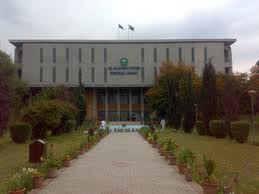
NATIONAL DEFENCE UNIVERSITY PAKISTAN


The National Defense University (NDU) is an institution of higher education funded by theMinistry of Defence of Government of Pakistan, intended to facilitate high-level training, education, and the development of national security strategy. The NDU is chartered by thePresident of Pakistan as its Chancellor, and the management of the NDU is vested in a three Star General from the Pakistan Armed Forces who is called the President of the University.Army's Lieutenant General Agha Muhammad Umer Farooq is serving as its current President. It is located in Islamabad, Pakistan.
The university's mission is "to impart higher education in policy and strategy formulation at various tiers with emphasis on national security and defence, and act as a national think tank". The school's master program is two-year long intensive study program.
Most of the students are selected civilians in Islamabad, and highly capable and educated military officers, graduated from the military institutions. Students take classes in advanced strategic methods, conflict resolutions, nuclear politics and diplomacy. The NDU's institutes serve the university in developing policies of the government, while also creating simulations and war games to help keep the military current with specific concerns.
COURSES
National Security and War Course
National Security Workshop
National Media Workshop
Command and Leadership Course
Defence and Intelligence Course
Information Operations Course
       Pinnacle Course

Monday, May 9, 2011

UNIVERSITY OF ENGINEERING AND TECHNOLOGY LAHORE PAKISTAN

University of Engineering and Technology, Lahore, commonly referred to as UET Lahore, is the oldest engineering university in Pakistan. It offers bachelors, masters, and doctoral degrees in a variety of engineering disciplines. UET is a state university and the governor of Punjab is the chancellor of the university. The vice-chancellor is the executive head and manages university functions. UET has six faculties, containing a total of 23 academic departments. According to the Higher Education Commission of Pakistan, UET is one of the top ranked engineering universities in Pakistan. In 2010, UET Lahore was ranked the 281stengineering and technology 


CAMPUSES
Besides the main campus in Lahore, a sub-campus known as University City campus (also in Lahore) was established at Kala Shah Kaku. It is called UET Lahore City campus. Its labs are much more well developed than main campus and main campus is going to be shifted to it.
Besides Kala Shah Kaku campus, other campuses includes RCET (Rachna College of Engnieering & Technology) which is a constituent college of UET Lahore. Situated at the hub of the Engineering industries of the Pakistan, Rachna College derives its name from the lands stretching between the rivers, the Ravi and the Chenab.
The campus of Rachna College of Engineering & Technology, Gujranwala is spread over an area of about 74 acres (300,000 m2), surrounded by a canal on the south and lush agricultural land on the remaining three sides. The College is on the left bank of Nokhar Branch Canal about seven kilometers off (East) G.T. Road, between Gakhar and Wazirabad. The College was inaugurated by Lt. Gen. (R) Khalid Maqbool Governor of Punjab on 15 January 2003, with the induction of the first batch of 105 students for B.Sc. in Electrical, Mechanical and Industrial & Manufacturing Engineering. The College has started the B.Sc. (Hons) Degree in Computer Science Department in October 2008.
The Faisalabad campus, located in Khuryanwala, has now been converted into a university sub-campus of UET Lahore.university in the world by QS World University Rankings